In the world of fine antiques, a missing piece of carving usually lowers a furniture item’s value. Yet for conservators, historians, and seasoned collectors, a flat, sawed-off top rail on an ornate 18th-century chair or an unexpected gap at the apex of an intricate gilded mirror frame tells a gripping story. Known colloquially among dealers as "crown chopping," the deliberate removal of royal emblems from domestic objects is a physical scar left behind by some of history’s most turbulent political upheavals.
When revolutions topple kings and queens, the battle against the old regime rarely stops at the palace gates. It enters the drawing room. For centuries, erasing the visual language of monarchy from everyday furniture, silverware, and interiors has served as both an act of revolutionary zeal and a desperate measure of self-preservation.
The French Revolution: Survival by the Saw
Nowhere is the practice of crown chopping more evident than in late 18th-century France. Following the storming of the Bastille in 1789 and the execution of King Louis XVI in 1793, the new French Republic waged a systematic campaign against all symbols of the Ancien Régime.
While crowds famously toppled public statues and chiselled royal coats of arms off stone facades, a quieter transformation took place inside private homes and workshops. Owning a piece of furniture adorned with a carved crown, a noble coronet, or the royal fleur-de-lis could be treated as evidence of counter-revolutionary sympathies—a charge carrying fatal consequences during the Reign of Terror.
To survive, aristocratic families who remained in France—alongside merchants reselling confiscated noble estates—hired cabinetmakers to sanitize their luxury goods. Intricate crestings on Louis XV and Louis XVI gilded mirrors, armchairs (fauteuils), and canopy beds were swiftly altered. Craftsmen took saws and chisels to the tops of frames, slicing away crowns and royal monograms while leaving the surrounding acanthus leaves and floral scrolls intact. Elsewhere, royal emblems painted on Sèvres porcelain or engraved on silver were ground down or overpainted with approved republican symbols, such as the Phrygian liberty cap.
The English Civil War and the Puritan Purge
A century and a half before the French Revolution, Britain experienced its own wave of anti-royal iconoclasm. During the English Civil War (1642–1651) and the subsequent Commonwealth period under Oliver Cromwell (1649–1660), Parliamentarians sought to dismantle the divine right of kings—literally and symbolically.
After the execution of King Charles I in 1649, Parliament famously ordered the medieval Crown Jewels to be broken up and melted down into coins. On a domestic and civic scale, Puritan zealots and officials of the new republic turned their attention to church pews, town halls, and heavy Jacobean oak panelling. Carved Tudor and Stuart roses, royal coats of arms, and crowns were hacked away with axes or planed flat with woodworking tools.
Ironically, when the monarchy was restored under King Charles II in 1660, crowns returned to English furniture design with a vengeance. The Carolean style of the late 17th century featured high-backed walnut chairs and lush giltwood mirrors crowned with elaborate carvings of royal crowns supported by winged cherubs (putti)—a direct, celebratory backlash against the austerity of Cromwell’s rule.
Echoes Across Other Revolutions
The impulse to scrub monarchy from the decorative arts has repeated itself wherever crowns have fallen:
• The American Revolution (1775–1783): As colonists rejected the rule of King George III, British royal symbols became targets of patriotic anger. Alongside pulling down royal tavern signs and melting lead statues into musket balls, colonists scraped British crowns and royal ciphers off imported silverware, longcase clocks, and high-backed chairs.
• The Russian Revolution (1917): Following the Bolshevik uprising and the fall of the Romanov dynasty, imperial emblems—most notably the tsarist crown and the double-headed eagle—were systematically stripped from nationalized palace furnishings, porcelain, and architectural interiors across Russia.
Reading the Scars Today
Today, antique collectors and conservators view historic alterations not as mere damage, but as compelling material provenance. When examining an antique frame or chair in the workshop, specialists look for specific physical clues that distinguish deliberate crown removal from ordinary wear and tear:
• Abruptly Flat Crestings: Many 17th- and 18th-century chairs and mirrors were designed with a dramatic pyramidal silhouette peaking at a central crown. If the top edge terminates unnaturally while the side carvings curve upward toward an empty space, a crown or coronet was likely sawed off.
• Disrupted Symmetry: Baroque and Rococo ornament relied heavily on strict symmetry. A flattened dip or subtly reworked leaf scroll directly at the apex of swirling foliage often marks where a royal emblem was excised.
• Tool Marks and Patina: Clean cross-grain saw or chisel marks along the top edge of a frame, darkened by centuries of oxidation and overlaid by later re-gilding, confirm that the alteration took place generations ago rather than in a modern workshop.
Conservation Case Study: The Cherub Cresting at Hatfield House
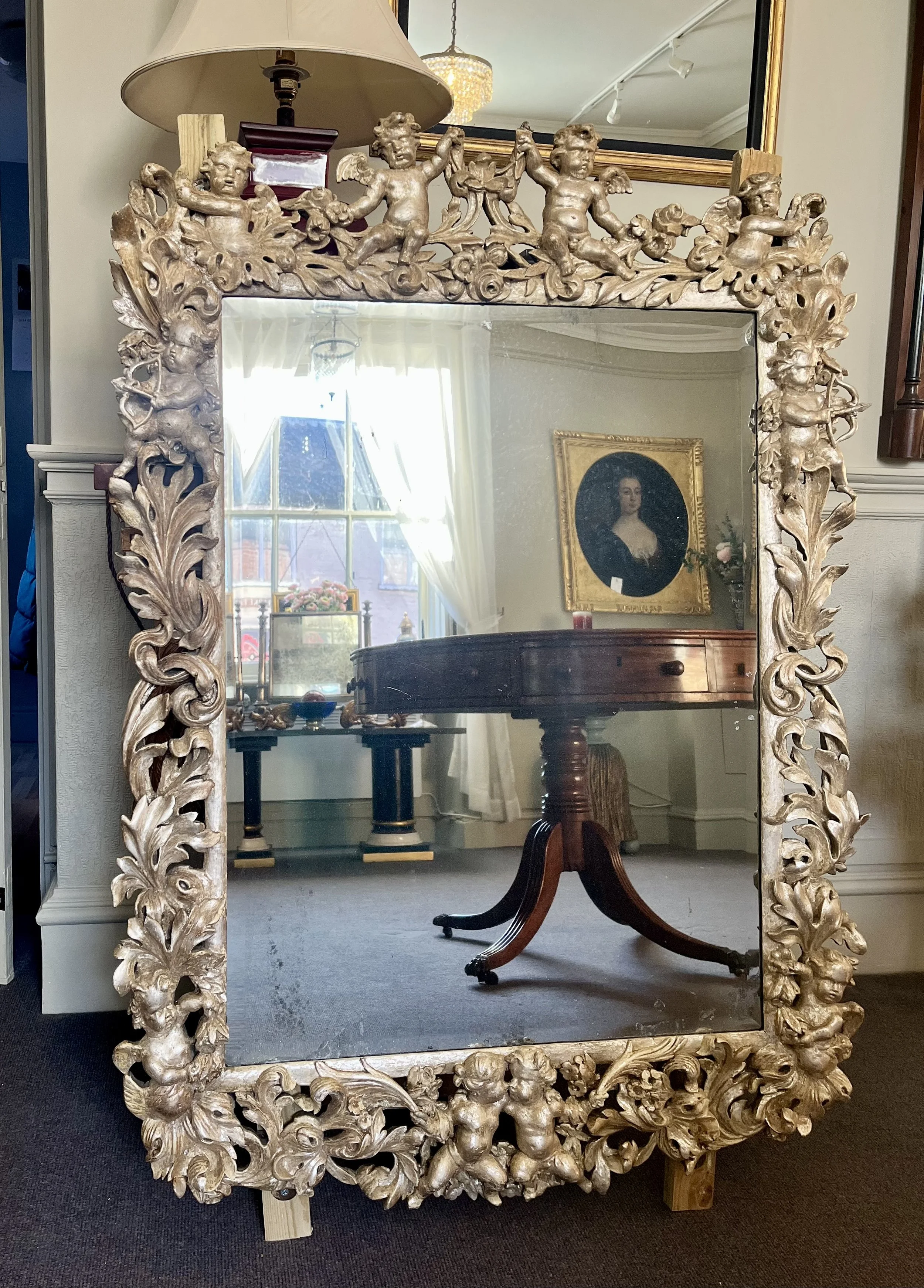
Object: Charles II Rectangular Carved Giltwood Mirror with Bevelled Plate
Date: Circa 1660–1685
Provenance: The Chinese Bedroom (formerly the Old Billiard Room), Hatfield House, Hertfordshire
Conservation & Restoration: Butler & Castell, Reepham, Norfolk
Myth, Memory, and Material Evidence
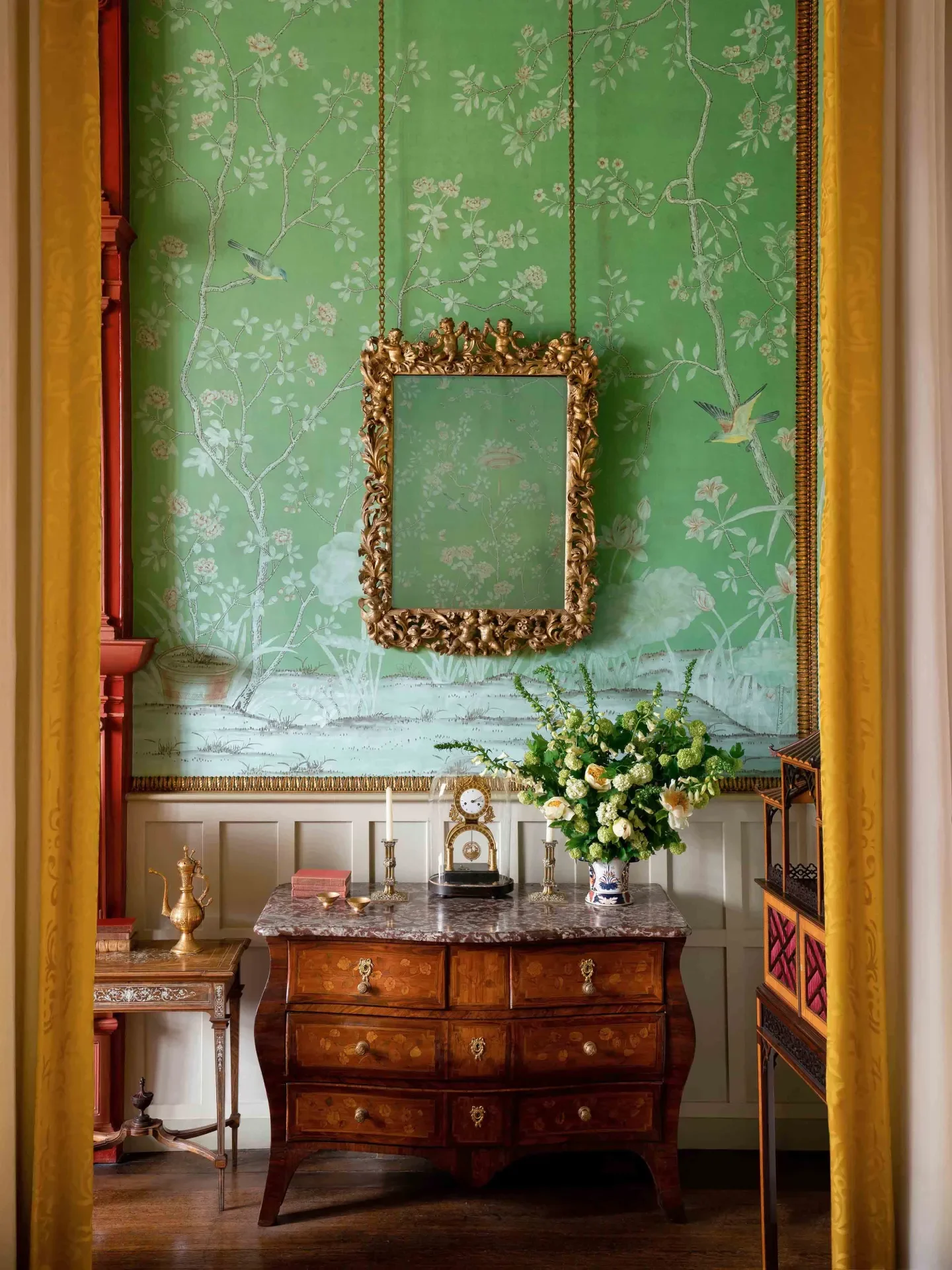
Hanging against the chinoiserie wallpaper of the Chinese Bedroom (formerly the Old Billiard Room) at Hatfield House is a rare late 17th-century rectangular looking glass, richly carved with deeply undercut acanthus scrolls, floral garlands, and winged putti. Like many historic English country house pieces missing their upper royalist insignia, the mirror may have long been accompanied by a classic piece of antique folklore: that Oliver Cromwell’s soldiers chopped the crown off the frame during the English Civil War.
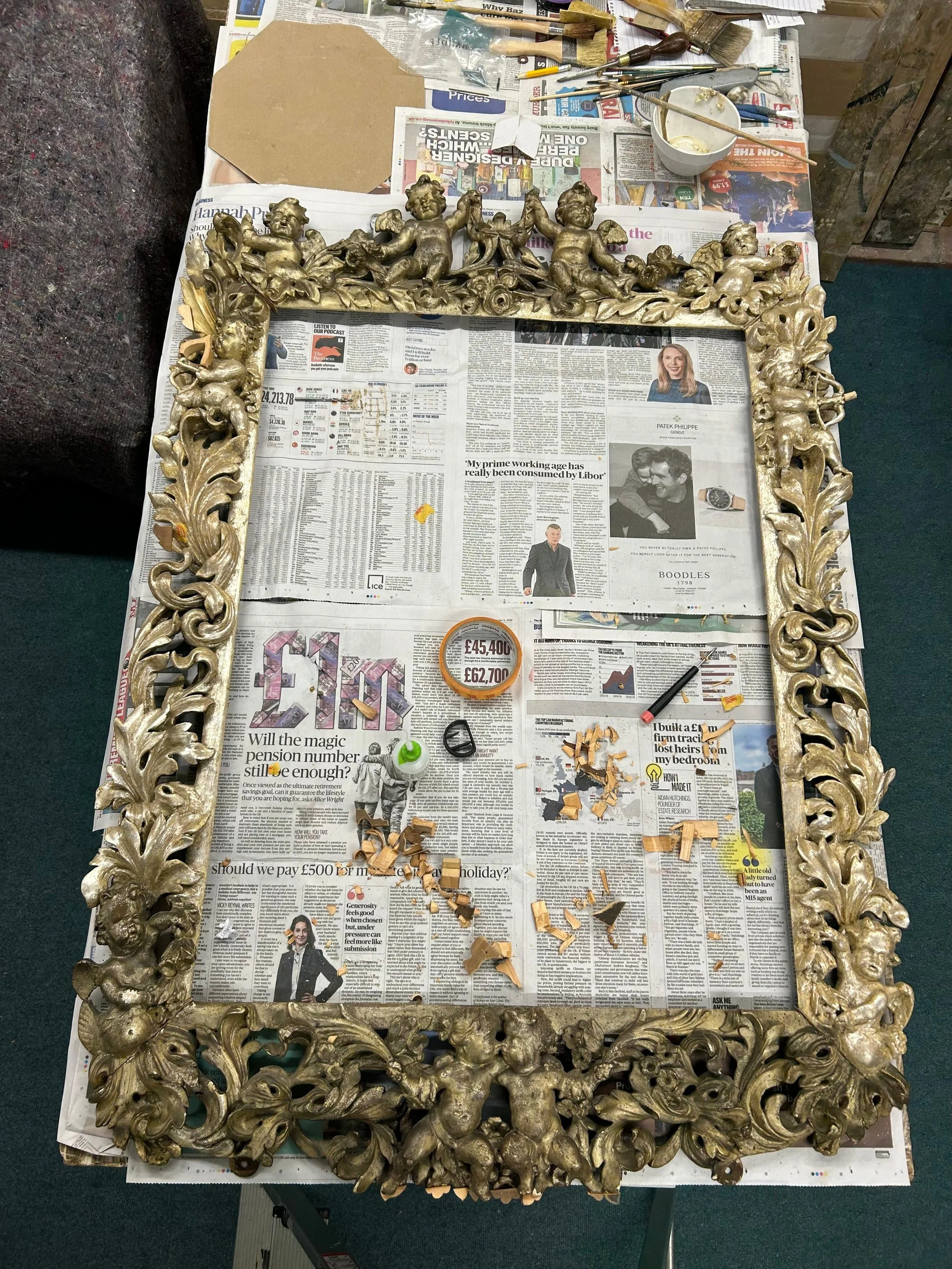
When the mirror was brought into our Reepham workshops as part of our ongoing conservation programme for Hatfield House, close examination of its timber structure, joinery, and gilding stratigraphy allowed us to separate romantic legend from genuine physical evidence.
What the Workshop Examination Revealed
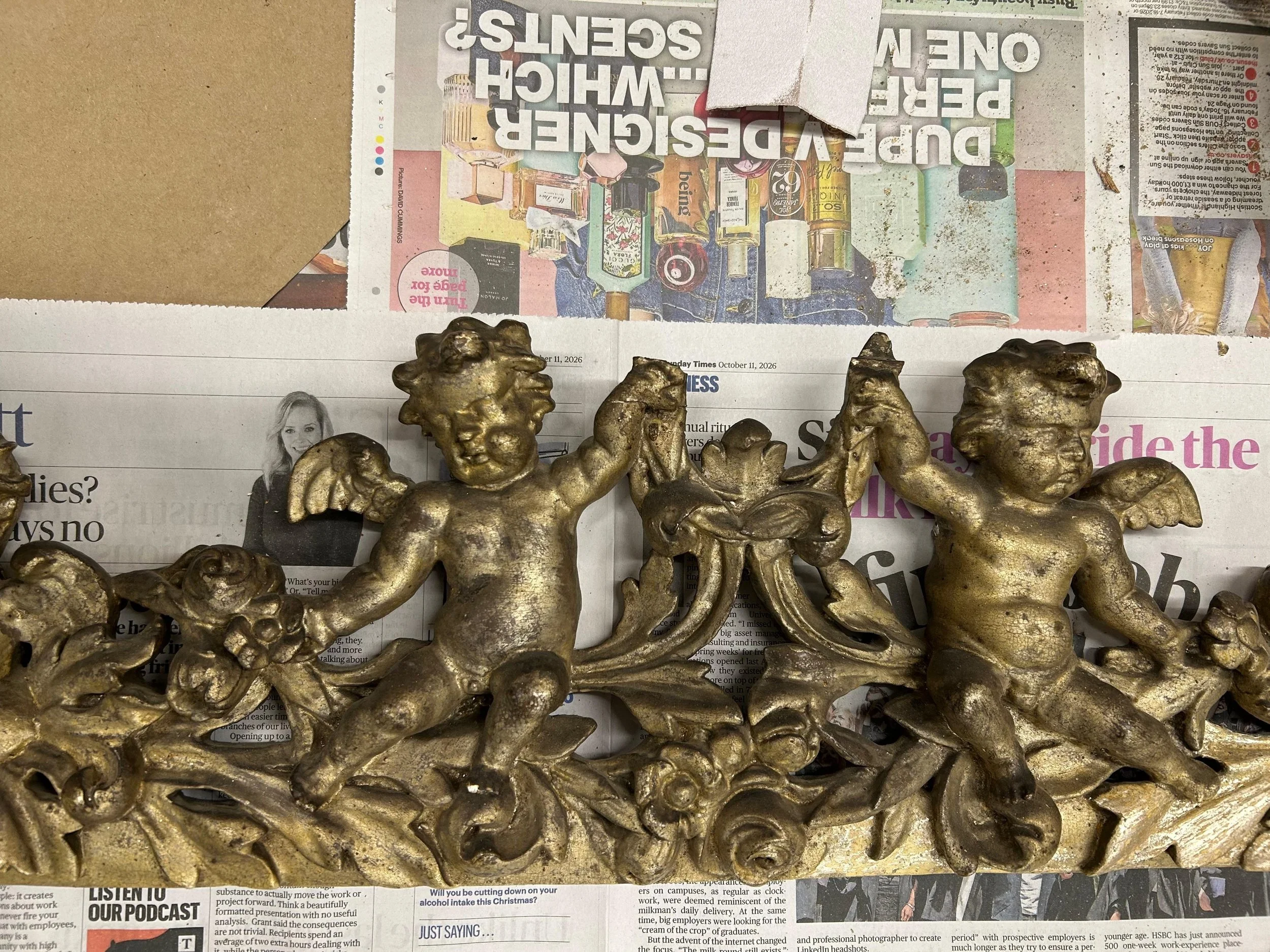
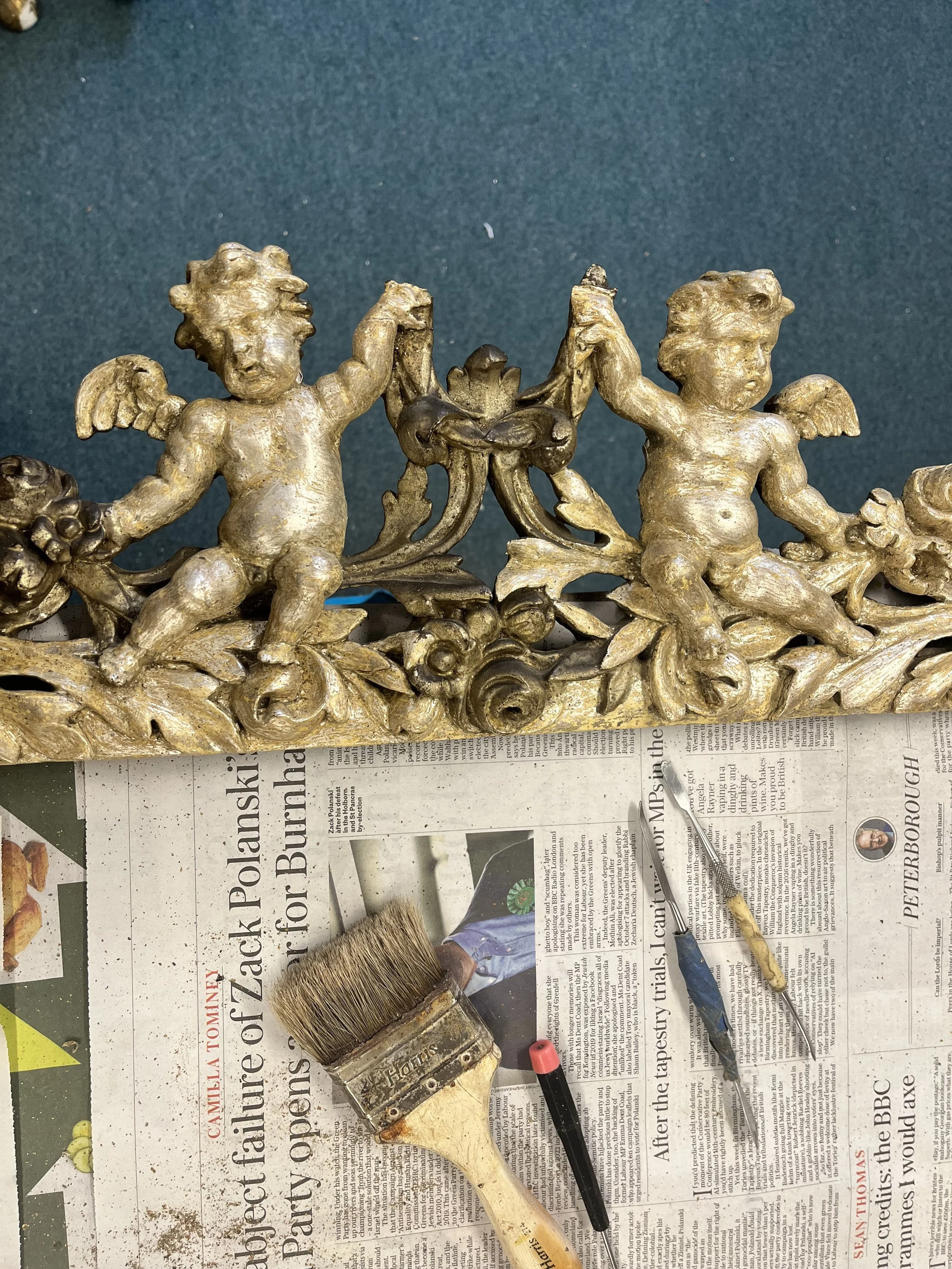
In late 17th-century royalist design, two symmetrical cherubs reaching upward at the top centre of a mirror frame were almost always carved to support a central royal crown or noble coronet—a motif celebrating divine right and noble lineage. On this frame, however, the hands of the two puttireach up to hold the curled tips of two stylized acanthus leaves flanking an open, U-shaped gap right at the apex.
Inspecting the top rail under raking light confirmed two key facts:
1. Authentic Post-Restoration Craftsmanship: The un-gilded reverse displays rough-hewn timber construction secured with hand-forged iron nails, while the carved ornament carries thick layers of traditional gesso and aged water-gilding. Stylistically and structurally, the mirror dates to the reign of King Charles II (c. 1660–1685)—meaning it was made after Oliver Cromwell’s death in 1658.
2. Deliberate Cross-Grain Severance: Viewing the top edge directly between the cherubs’ raised hands reveals two flat, angled cross-grain saw or chisel cuts rather than jagged accidental breaks. A carved crown or Earl’s coronet (the Cecil family held the title of Earls of Salisbury until 1789) was intentionally cut away from its two supporting struts, and aged gold/bronze paint and darkened gesso extend slightly over the edges of the oxidized wood—proving the removal happened centuries ago, prior to a historic re-gilding campaign.
Why Was the Crown Removed?
If Cromwell’s troops did not wield the saw, why was the central emblem deliberately removed? Three historically grounded explanations stand out:
• The Glorious Revolution of 1688: Following the deposition of the Catholic King James II and the accession of William and Mary, some Protestant aristocratic households discreetly removed overt Stuart royalist emblems from furnishings to distance themselves from Jacobite associations.
• Architectural Relocation: When the mirror was moved from a grand state apartment into a secondary space such as the Old Billiard Room, a tall, protruding crest may have been trimmed down to clear a lower ceiling height or cornice.
• Symmetrical Estate Repair: If one side of a fragile, pierced crown snapped during historic cleaning or handling, an estate carver would commonly saw both supporting struts cleanly flush so the remaining foliage read as a balanced composition—an alteration that later generations naturally romanticized as the work of Cromwell’s Roundheads.
Conservation Philosophy & Treatment
Our objective was to preserve the mirror’s full historical biography rather than erase its past:
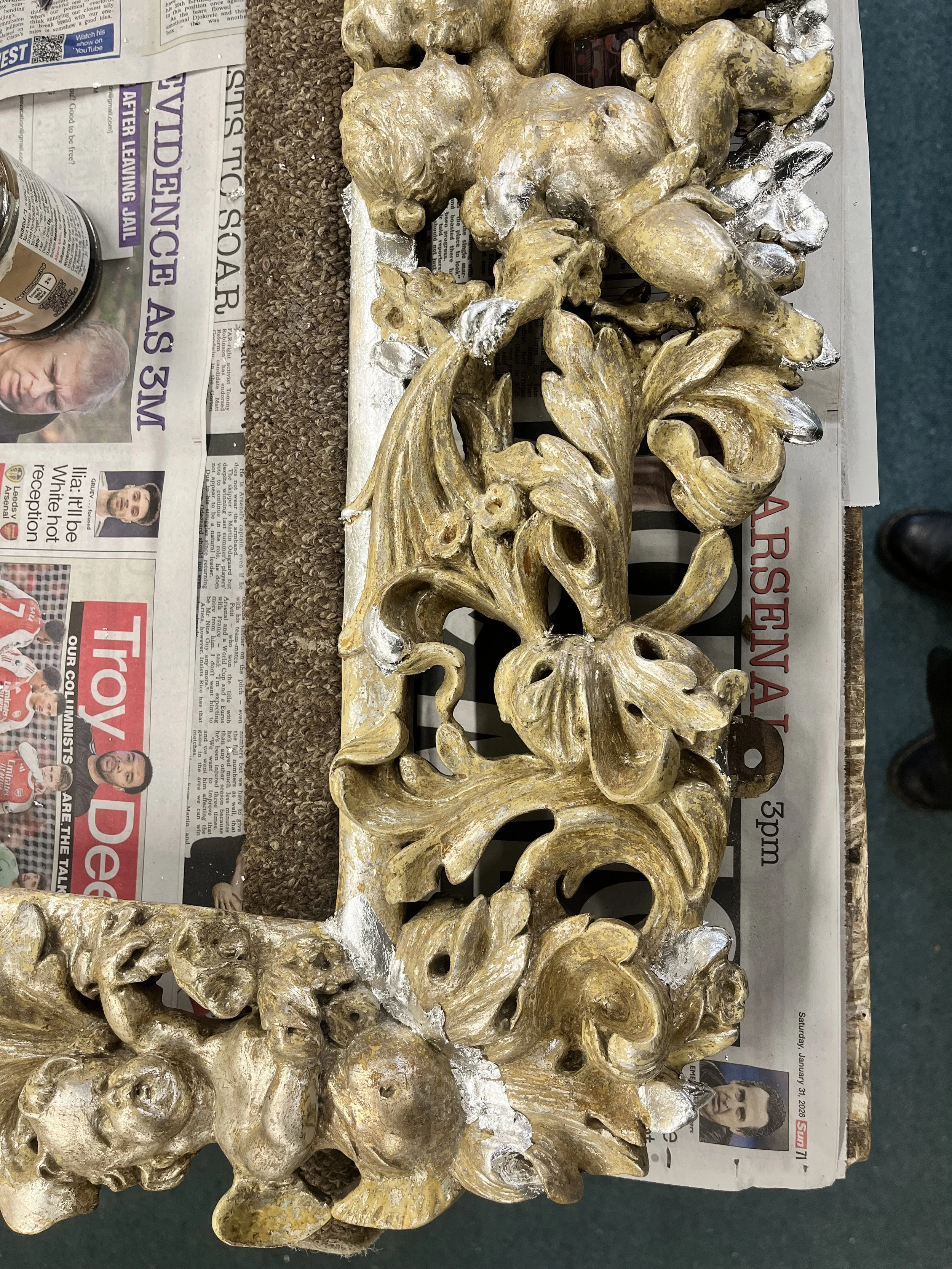
• Preserving Historical Alterations. Rather than conjecturally carving a new crown to replace what was lost centuries ago, the historic cross-grain saw cuts were carefully documented and left intact as tangible evidence of the object’s lived history.
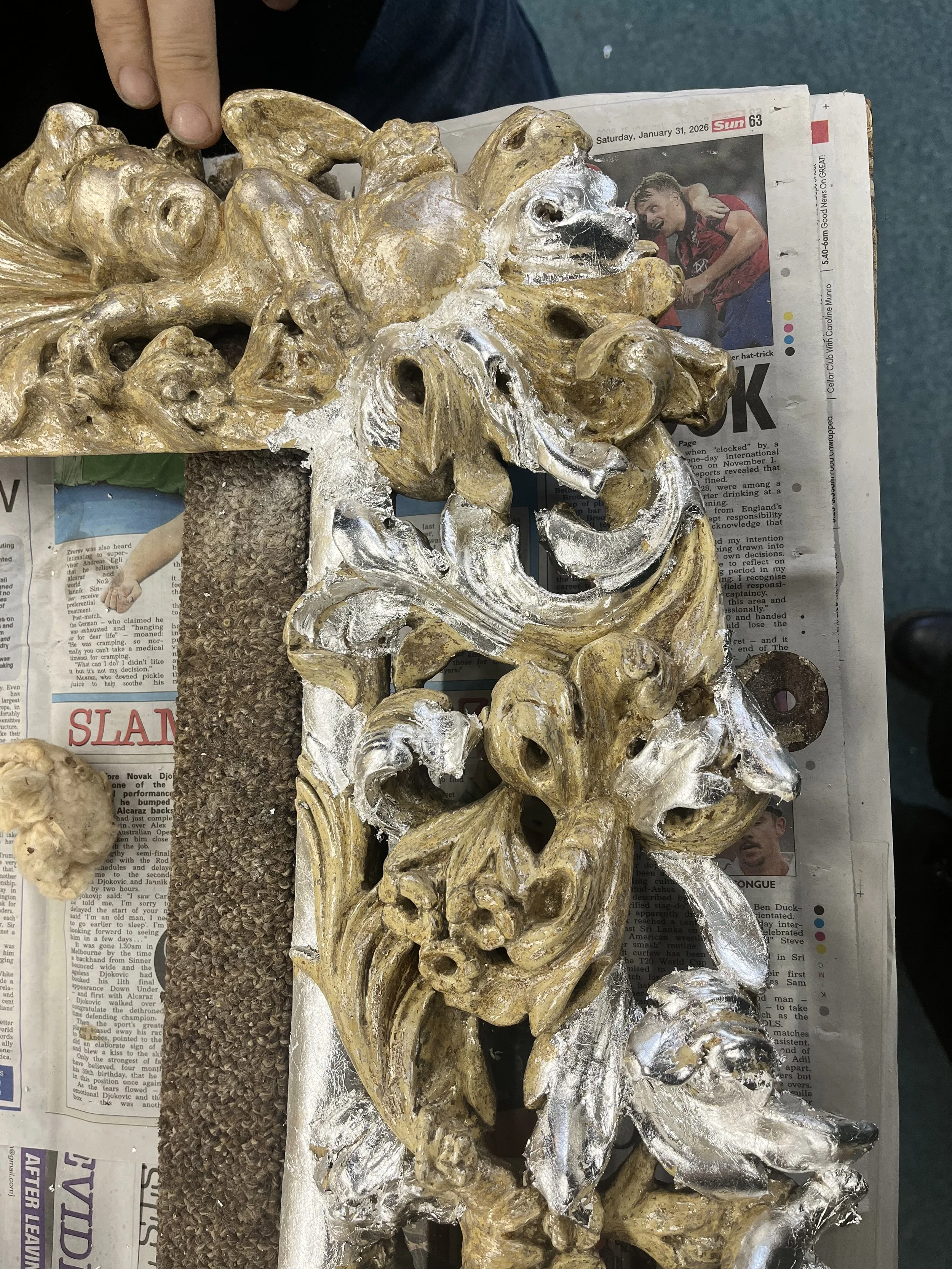
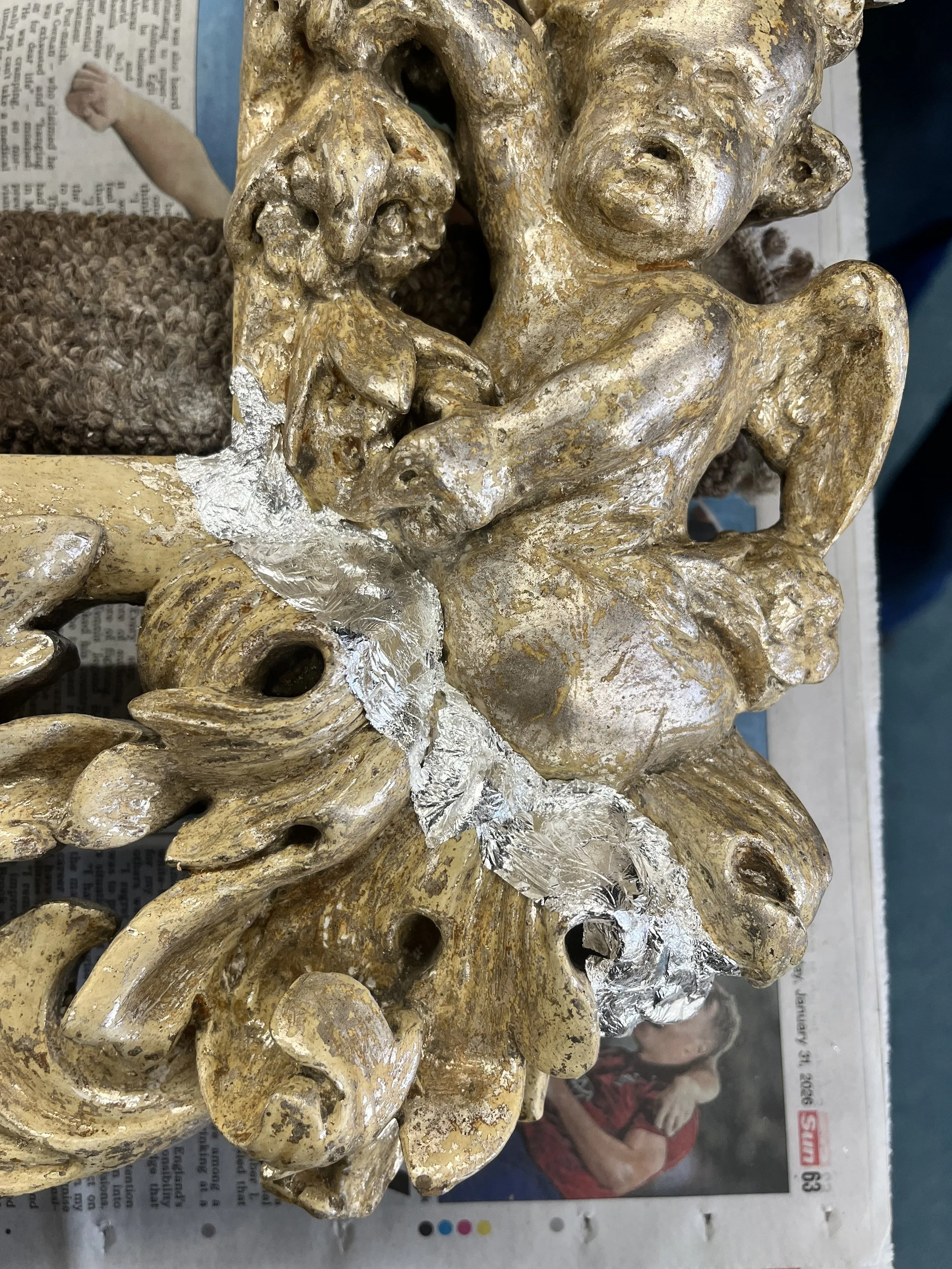
• Cleaning, Consolidation & Structural Stabilization.The mirror was meticulously dry stripped to reveal the original surface. Loose and lifting gesso and water-gilt surfaces were painstakingly consolidated using traditional conservation adhesives, securing vulnerable edges without disturbing the authentic patination.
• Sympathetic Toning & Reintegration. Minor areas of fresh loss were filled, gilded and toned to harmonize with the surrounding 17th century gilding, ensuring the mirror can safely return to display in the Chinese Bedroom for generations to come.
A Mystery Preserved in Wood and Gold
Ultimately, while stylistic analysis places the mirror firmly in the Carolean period, the exact date of its carving—and the precise hand that wielded the saw—will always remain open to intrigue. Without a surviving seventeenth-century workshop receipt, we can never be entirely certain whether the frame was crafted slightly earlier, making it a genuine casualty of Cromwellian iconoclasm, or whether its crest fell victim to the Glorious Revolution, a low ceiling, or an estate carpenter’s practical repair decades later.
We may never know for sure—and in many ways, that enduring mystery is what makes conserving historic country house furniture so compelling. Whether the scar at its apex is a mark of Puritan zeal or later domestic history, the surviving putti and gilded foliage still hanging handsomely against the chinoiserie wallpaper at Hatfield House bear silent witness to a time when the central symbol of monarchy was deliberately excised for the piece to survive.
Chinese Bedroom - Hatfield House